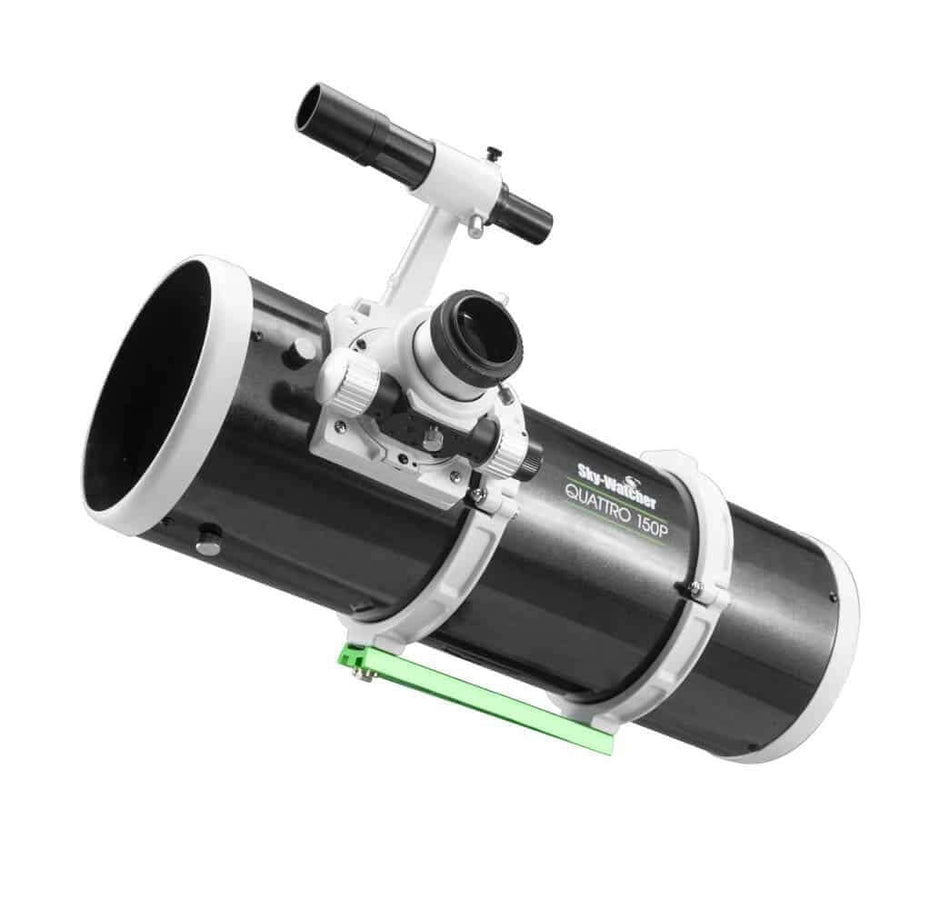
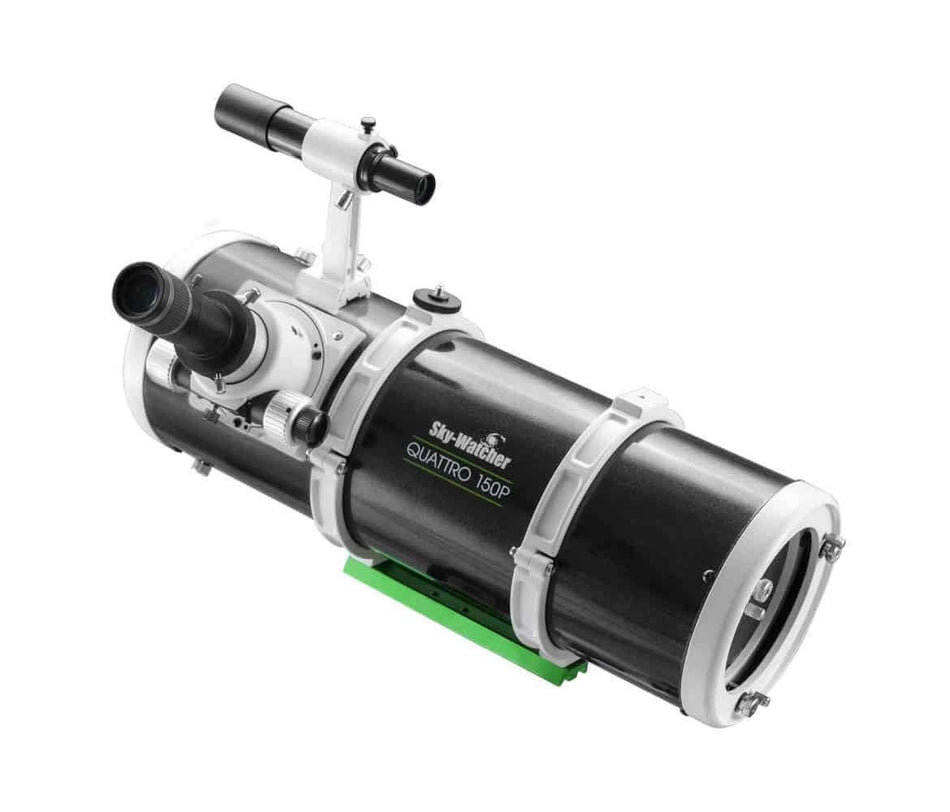
The Newtonian telescope tube is the most popular reflector design in amateur and semi-professional astronomy: a parabolic primary mirror collects light and reflects it onto a small flat secondary mirror angled at 45°, redirecting the optical path sideways to the focuser. The result is an open, fast and versatile optical system, equally suited to visual observation and deep-sky astrophotography.
Newtonian optical tubes are defined by their focal ratio (from f/4 to f/8), primary mirror diameter (from 100 mm to over 300 mm), and the quality of the mirror coating. They deliver the best balance between light-gathering power and cost — significantly more aperture per pound or euro than refractors or catadioptrics of equivalent size.
Newtonian or another telescope? How to choose the right tube
The classic Newtonian tube differs from other reflector designs mainly in the position of the focal point: lateral and near the top of the tube, comfortable for near-zenith viewing on equatorial or altazimuth mounts. Compared to a Dobsonian — which uses the same optics but integrates them into a fixed wooden altazimuth rocker — a standalone Newtonian tube offers greater flexibility for observers who already own an EQ or goto mount.
Compared to catadioptric designs (Schmidt-Cassegrain, Maksutov), the Newtonian delivers shorter focal lengths at the same aperture, wider fields of view, and excellent light throughput. Fast models (f/4–f/5) benefit from a coma corrector for astrophotography with APS-C or full-frame sensors. Newtonian tubes at f/6–f/8 are more forgiving and well suited to visual planetary observation as well.
When to choose a Newtonian tube:
- You want maximum aperture at minimum cost
- You already own a mount and need the optical tube only
- You are targeting nebulae, galaxies and star clusters with a DSLR or mirrorless camera
- You want a single instrument that works for both visual use and imaging

 -13%
-13% -3%
-3% -3%
-3% -3%
-3% -3%
-3% -3%
-3% -3%
-3%


